Disclosure: This post contains affiliate links. If you purchase through these links, I may earn a small commission at no extra cost to you. I only recommend products I personally find useful.
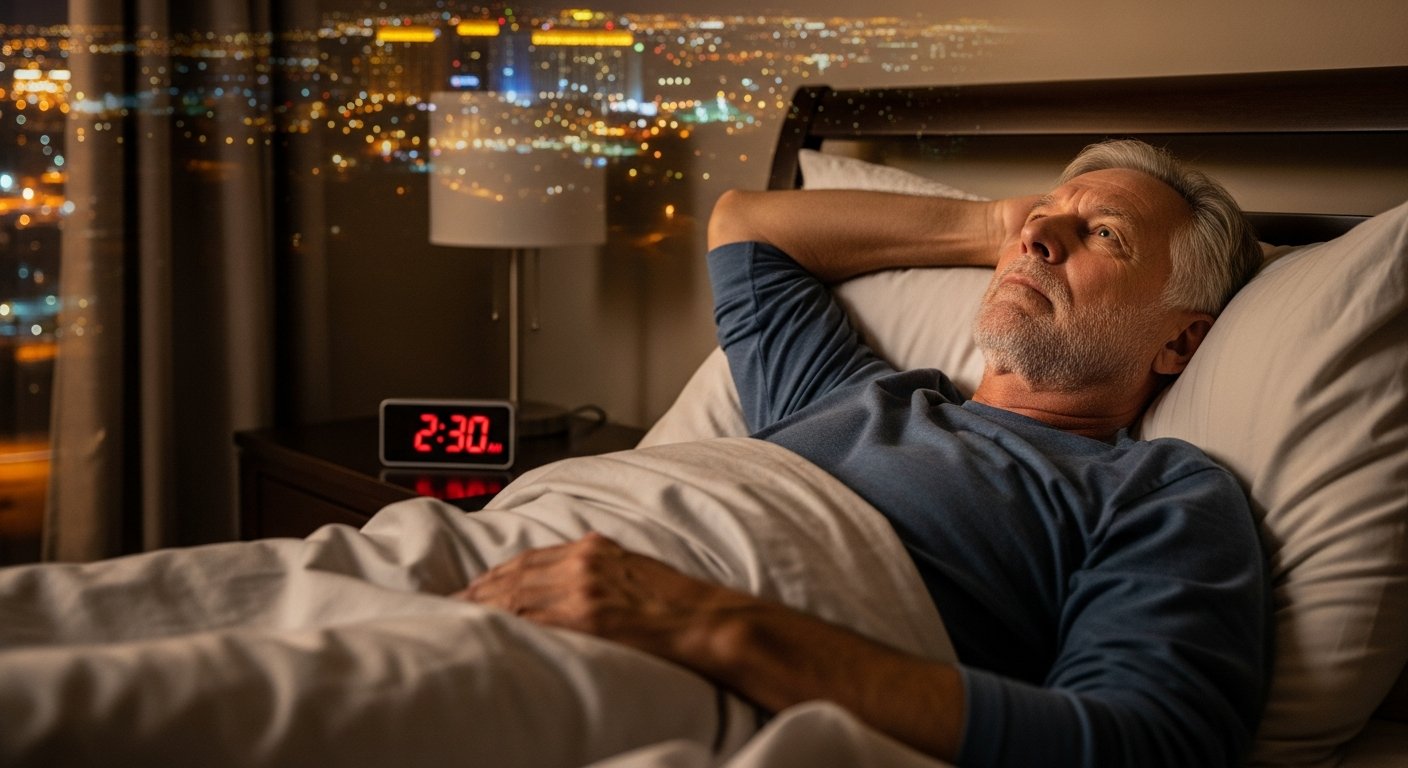
It was 11:30 at night and still 94°F outside. I know because I checked before I shut off my Tesla and walked inside. The A/C had been running since 7 a.m. — twelve straight hours — and when I looked at my thermostat, the bedroom was holding at 76°F. Not 70. Not 68. Seventy-six. Sleep problems seniors face are real anywhere, but Las Vegas layers on challenges most retirement guides never mention. And if you’re over sixty, your body cares a lot more about temperature than it used to. That’s the combination that makes sleep problems seniors deal with here genuinely brutal in ways other cities don’t prepare you for. I started paying serious attention to this about three years ago, after I realized I was waking up tired more mornings than not — and it wasn’t age. It was the city.
Here’s what I figured out, and what actually helped.
Why Sleep Problems Seniors Face Get Worse in Las Vegas After 60
The science isn’t complicated. As we get older, our bodies produce less melatonin — the hormone that tells you it’s time to sleep. Our sleep architecture also shifts. We spend less time in deep, restorative sleep and more time in lighter stages, which means we wake up more easily. According to the National Institute on Aging, up to 50% of adults 65 and older report having trouble sleeping — which explains why sleep problems seniors experience are the most common complaint in that age group.
That’s the baseline. Now add Las Vegas.
This city creates sleep problems seniors wouldn’t face in most places. First, the heat. Optimal sleep happens when your core body temperature drops slightly — that’s why the recommended bedroom temperature is between 60 and 70°F. In July and August here, nighttime lows regularly sit at 88 to 94°F. Your A/C is fighting that around the clock. Second, light. The Strip is twenty minutes from most neighborhoods, and light pollution is real. If you live near Flamingo, Sahara, or the I-15, you know your blinds aren’t doing enough. Third, noise. Whether it’s traffic, helicopters, or a neighbor who keeps casino hours, the ambient sound baseline here runs higher than in quieter cities.
None of these are impossible to solve. The sleep problems seniors face in this city are real, but they’re not permanent. You have to actually address them — not just hope they go away.
The Cooling Problem: What It Actually Costs and How to Get Help
Running air conditioning twenty-four hours a day in a Las Vegas summer isn’t optional for seniors — it’s a health issue. Heat-related illness is the number one weather-related cause of death in the U.S., and older adults are at significantly higher risk. But cooling a home here in July can push your NV Energy bill past $300 a month. That’s real money.
What a lot of people don’t know is that Nevada has a program specifically designed for this. The Energy Assistance Program — Nevada’s version of the federal LIHEAP — provides cooling and heating assistance to income-eligible households. For fiscal year 2026, Nevada received $15.6 million in LIHEAP funding. Benefits range from a minimum of $360 up to $3,136, applied directly to your utility account.
Income eligibility is set at 150% of the federal poverty level. For a single-person household, that’s roughly $22,590 a year — or about $1,882 a month. Households with adults 60 and older are prioritized. You can call the Las Vegas office directly at 702-486-1404, or apply through Access Nevada at the Division of Welfare and Supportive Services. The physical office is at 330 E. Flamingo Rd., Suite 55.
📌 Related: Senior Part Time Jobs in Las Vegas 2026 — What Works
I’ve told three neighbors about this program. Two of them qualified and didn’t know it existed.
Beyond the assistance program, the practical steps matter too. Blackout curtains do double duty — they block both light and heat. A good set can drop your bedroom temperature by a few degrees without touching the thermostat. I switched to a pair of NICETOWN thermal blackout curtains in the bedroom about two years ago and the difference in afternoon heat was noticeable. They’re not a cure, but they’re part of the system.
🌡️ For blocking both heat and light: NICETOWN Thermal Blackout Curtains · Moisture Chamber Sleep Mask (100% Blackout)
Light and Noise: The Two Sleep Killers Nobody Talks About Enough
Back when I was dealing cards at a locals casino on the west side, I used to get home around 3 a.m. The sun came up at 5:30. My bedroom faced east. I learned very quickly that light is not subtle — your brain reads it as a signal to wake up, regardless of how many hours you’ve slept. That’s biology, not preference.
For seniors, this is amplified. Our circadian rhythms become more sensitive to light cues as we age, not less. Morning light — even filtered through regular curtains — can end your sleep an hour or two before your body is ready. If you’re waking at 5 a.m. and don’t feel rested, light is the first thing to check.
A sleep mask is the lowest-cost, fastest solution. Not the cheap foam ones — those press on your eyelids and actually disrupt sleep. The better design creates a small chamber over your eyes so there’s no pressure. For those who decide to try one, check the fit carefully; it matters more than the material.
Noise is the second issue. Las Vegas doesn’t have quiet hours in any meaningful sense. If traffic, neighbors, or ambient city sound is waking you up, white noise works — not because it drowns out the problem sound, but because it reduces the contrast between silence and the spike. Your brain notices sudden changes more than sustained sounds. A consistent background hum smooths that out. A basic machine or even a fan can work. Earplugs are effective too, though some people find them uncomfortable long-term.
📌 Related: Weight Loss Programs Seniors Over 60 Las Vegas: What Wo
One thing I’d caution against: relying on TV or podcasts to fall asleep. The unpredictable volume and content changes keep part of your brain on alert. It feels like it helps, but the sleep data doesn’t support it.
Sleep Habits That Actually Fix Sleep Problems Seniors Struggle With After 60
The National Council on Aging recommends 7 to 9 hours of sleep for older adults — same as younger people, despite the popular myth that seniors need less. What changes is the architecture, not the requirement. You need the same hours; you just might need to be more deliberate about getting them.
A consistent wake time is the single most effective lever most people aren’t using — and it’s the first thing that helped with the sleep problems seniors here in Las Vegas often report. Not bedtime — wake time. Pick a time and hold it every day, including weekends and the mornings after bad sleep. It’s counterintuitive, but sleeping in after a rough night makes the next night worse by shifting your sleep pressure. If you’re going to anchor one thing, anchor when you get up.
Caffeine has a longer half-life in older adults than in younger ones. If you’re drinking coffee at 2 p.m., roughly half of that caffeine is still active at 8 p.m. Cutting off caffeine at noon is a reasonable target for most people over sixty.
Alcohol is a common one to address. A glass of wine helps some people fall asleep, which is real — alcohol is a sedative. The problem is the rebound. As your body metabolizes it, sleep becomes fragmented in the second half of the night. You fall asleep easier and sleep worse overall. That trade-off gets less favorable as we age.
For seniors dealing with persistent insomnia — one of the most common sleep problems seniors face that doesn’t resolve on its own — Cognitive Behavioral Therapy for Insomnia — CBT-I — is now the first-line recommended treatment ahead of sleep medication. The research is consistent: it produces longer-lasting improvements than pills, with no side effects. Your primary care doctor can refer you, and there are also online CBT-I programs if in-person isn’t practical.
If you’ve noticed significant changes in your sleep — loud snoring, gasping, or waking up unrested no matter how many hours you get — that’s worth mentioning to a doctor. Sleep apnea is underdiagnosed in older adults and very treatable. It’s not just a snoring problem; untreated sleep apnea is linked to increased cardiovascular risk.
For more on how sleep connects to cognitive health, I wrote about this in my earlier piece on brain health for Las Vegas seniors over 60 — the overlap is significant.
Frequently Asked Questions
How many hours of sleep do seniors over 60 actually need?
The National Institute on Aging recommends 7 to 9 hours per night — the same range as younger adults. The common belief that older adults need less sleep isn’t supported by current research. What changes with age is sleep quality and architecture, not the requirement itself.
Is it normal to wake up multiple times during the night after 60?
More frequent waking is one of the sleep problems seniors commonly report, because we spend more time in lighter sleep stages. Waking once or twice is generally normal. If you’re waking four or five times and can’t get back to sleep, or if you feel consistently exhausted despite adequate hours in bed, that’s worth discussing with a doctor.
Does Nevada’s energy assistance program (LIHEAP) really cover cooling costs?
Yes. Nevada’s Energy Assistance Program is federally funded through LIHEAP and covers both heating and cooling. For FY2026, benefits range from $360 to $3,136. Income eligibility is 150% of the federal poverty level, and households with adults 60+ are prioritized. Call 702-486-1404 or visit the Las Vegas DWSS office at 330 E. Flamingo Rd.
What’s the ideal bedroom temperature for sleep in Las Vegas summers?
Research points to 60–68°F as the optimal range for sleep. In Las Vegas summers, that means your A/C is working hard overnight. If hitting that range consistently isn’t affordable, even getting to 72–74°F with blackout curtains and a fan is meaningfully better than a hot room. The direction matters even if the exact target isn’t reachable every night.
Is melatonin safe for seniors to take for sleep?
Melatonin is generally considered safer for seniors than prescription sleep medications, but it’s not without considerations. Older adults metabolize it more slowly, so lower doses (0.5mg to 1mg) are often as effective as higher doses. Talk to your doctor before starting, particularly if you take blood thinners or other medications. Melatonin works best for circadian rhythm issues — resetting sleep timing — rather than general insomnia.
References
- National Institute on Aging — Sleep and Older Adults
- National Council on Aging — Sleep Statistics for Older Adults 2026
- National Council on Aging — Tips to Better Sleep for Older Adults
- Nevada DWSS — Apply for the Energy Assistance Program
- LIHEAP Clearinghouse — Nevada Profile
- Sleep Foundation — Insomnia and Older Adults
Disclaimer: This article is for informational purposes only and does not constitute professional medical or fitness advice. Consult your doctor before starting any new health routine.