Disclosure: This post contains affiliate links. If you purchase through these links, I may earn a small commission at no extra cost to you. I only recommend products I personally find useful.
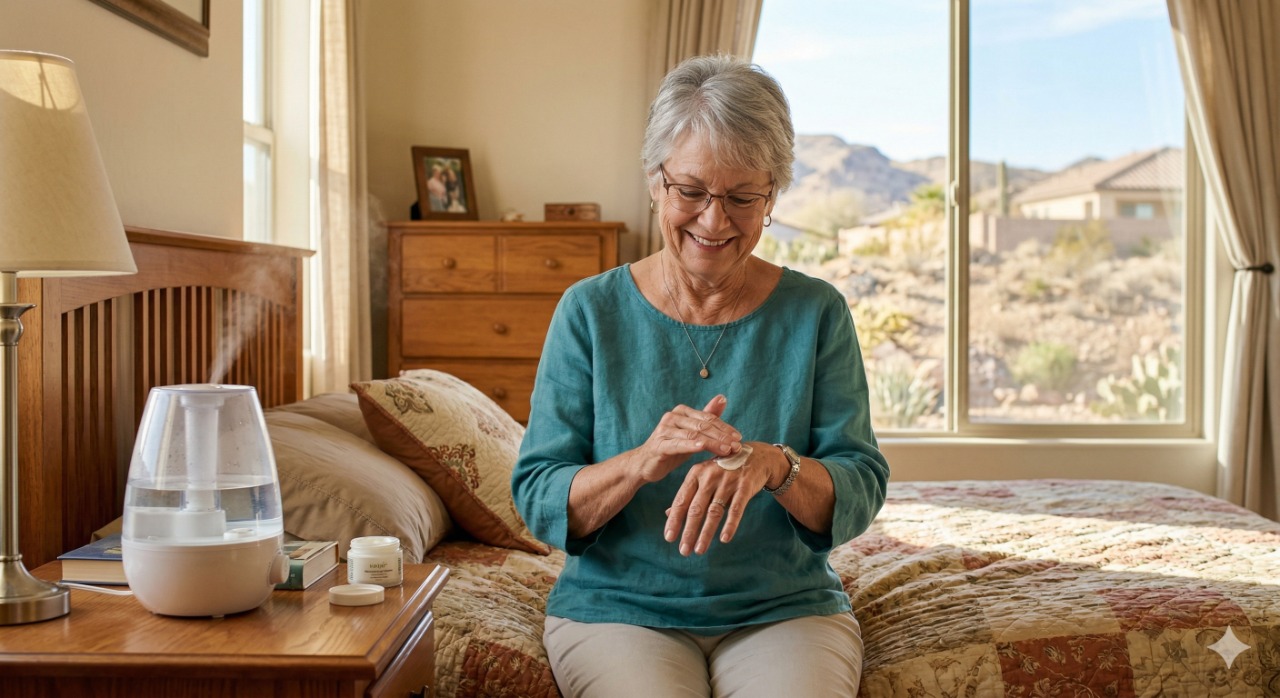
Last Tuesday I had a passenger — a woman, probably early seventies, just moved here from Portland six months ago. She climbed into my Tesla and the first thing she said wasn’t “hello.” It was: “My skin is falling apart.”
She wasn’t being dramatic.
She showed me her forearm. Cracked. Rough like sandpaper. A thin line of blood where the skin had split near her elbow. She’d been using the same moisturizer she’d used in Oregon for thirty years. “It worked fine there,” she said. “Here it does nothing.”
I told her I understood completely. I’ve been here fifteen years. It took me about two full years to figure out how to keep my skin from turning into a desert cactus — which, considering we live in an actual desert, feels like a reasonable metaphor.
Las Vegas doesn’t just feel dry. It is dry. Scientifically, measurably, relentlessly dry. And once you’re past sixty, your skin is already fighting that battle with fewer tools than it used to have.
Why Las Vegas Is Genuinely Different From Anywhere Else
Back when I was in engineering, we always said: if you don’t understand the environment, you can’t solve the problem. So let’s understand the environment first.
According to the American Academy of Dermatology, skin cancer is the most common cancer in the U.S., and cumulative UV exposure — especially in high-UV climates like Las Vegas — is the leading preventable cause.
The average humidity in Las Vegas sits between 17% and 30% depending on the month. In June, it regularly drops to 17%. The range that dermatologists consider optimal for skin health is 40% to 70%. We’re not close. We’re not even in the same neighborhood.
Meanwhile, the UV index hits 11 — classified as “Extreme” — through most of the summer. July averages 106°F. Nevada ranks 9th highest for UV risk in the entire country. That’s not a fun statistic. That’s a warning.
Now here’s what most people miss: the inside of your home is often worse than outside. Casino buildings, shopping malls, and standard Las Vegas residential HVAC systems all recirculate air that strips out whatever humidity remains. I spent seven years as a dealer in a locals casino on the west side. That air? Brutally dry. My hands cracked every winter. Every single year until I figured out what I was doing wrong.
The issue is called Transepidermal Water Loss — TEWL. Your skin loses water through its surface constantly. In a humid climate, that process is slow enough that your body keeps up. In Las Vegas humidity, TEWL accelerates by as much as three times compared to coastal environments. Your skin evaporates moisture faster than it can replace it.
That’s the environment. Now let’s talk about what happens to skin after sixty.
What Changes After 60 That Makes This Worse
Your skin at sixty-five is not the skin you had at forty. Biologically, several things shift — and all of them make desert dryness harder to handle.
First, sebaceous gland activity decreases. Your skin produces less of its own oil — the natural barrier that slows moisture evaporation. Less oil means faster water loss. Less water means tighter, thinner, more fragile skin.
📌 Related: Nursing Home vs Home Care Las Vegas: Real Cost Guide
Second, ceramide production drops. Ceramides are the molecular “glue” that holds skin cells together and maintains the protective barrier. When ceramide levels fall, the barrier leaks. Irritants get in more easily. Water gets out more easily.
Third, collagen and hyaluronic acid — both naturally hydrating compounds — decline with age. Skin becomes less able to hold onto what moisture it does absorb.
The result: dermatologists estimate that roughly 75% of adults over 65 experience xerosis, the clinical term for pathologically dry skin. In desert climates, that number is higher. A lot higher.
If you’re in your sixties and living in Las Vegas and your skin feels constantly tight, itchy, or papery — you’re not imagining things. The math is working against you. The good news is that the math is also solvable.
The Real Problem With What Most People Use
The passenger I mentioned — the woman from Portland — was using a lightweight daily lotion. A popular brand. Totally fine for Portland. Completely inadequate for here.
Lotions are mostly water. In a high-humidity environment, they work because the air around you helps maintain skin hydration. In Las Vegas, a lotion can actually accelerate drying — the water in the formula evaporates quickly and sometimes pulls moisture from your skin along with it.
What works here is different. Creams and ointments — thicker formulations that create a physical barrier — outperform lotions in low-humidity climates. The specific ingredients matter too. Here’s what to look for:
- Ceramides: Restore the skin barrier directly. CeraVe is the most commonly recommended budget option. It’s in my medicine cabinet right now.
- Hyaluronic acid: Draws moisture from deeper skin layers. Effective, but only works if you apply it to damp skin — it needs something to draw from.
- Glycerin: A humectant that holds water in the skin. Works well layered under a thicker cream.
- Shea butter or petrolatum: Occlusive agents that form a physical barrier. Heavy, but effective at sealing moisture in overnight.
What to avoid: fragrances, alcohol-based products, and anything labeled “refreshing” or “light.” In Las Vegas, light doesn’t cut it after sixty.
The Three-Minute Rule That Actually Works
Here’s the most important practical thing I can tell you, and it came from a dermatologist I drove to the airport about three years ago. She was a skin specialist. We talked the whole ride.
She said: “Moisturizer doesn’t add water to your skin. It locks in the water that’s already there. The window is three minutes after you get out of the shower.”
Three minutes. That’s it.
Pat — don’t rub — yourself dry with a soft towel. Leave a little moisture on the skin surface. Then immediately apply your cream. If you wait until you’re fully dry and dressed, you’ve already lost most of the benefit.
📌 Related: Memory Care Facilities Las Vegas: Senior Options 2026
The other piece of the routine that matters: water temperature. Hot showers feel good. Hot showers in a dry climate are a mistake after sixty. Hot water strips sebum — the natural oil your skin already doesn’t produce enough of. Lukewarm is better. Not cold. Just lukewarm.
Controlling Your Indoor Environment
I ran the numbers on this once — old engineering habit. If Las Vegas outdoor humidity averages 25%, and your HVAC is recirculating dry air without adding moisture, your indoor humidity can drop below 20%. That’s drier than many deserts.
A humidifier is not optional here. It’s infrastructure.
The target range is 45% to 60% indoor humidity. A basic hygrometer — they cost $10 to $15 — will tell you where you actually are. Most Las Vegas homes without humidifiers run at 15% to 25% in summer. That number explains a lot of itchy nights.
For bedroom-only use, an ultrasonic humidifier in the $40 to $80 range handles a standard room well. For whole-home coverage, a console model or a HVAC-integrated humidifier is worth the investment. I run one in the bedroom year-round. My skin quality shifted noticeably within a few weeks of starting.
Don’t Forget the Sun — It’s Part of the Moisture Problem
UV exposure at Las Vegas levels doesn’t just cause sunburn and long-term skin damage. It also directly degrades the skin barrier.
UV radiation breaks down ceramides. It accelerates the breakdown of collagen. It increases inflammation, which further damages the barrier that was already compromised by low humidity. The damage compounds.
SPF 30 or higher, broad-spectrum, applied every morning regardless of whether you plan to go outside. Even indirect sunlight through windows accumulates over time. I didn’t take this seriously until my sixties. I wish I had started earlier.
For the face specifically: look for a moisturizer with built-in SPF so you’re not adding an extra step. CeraVe, La Roche-Posay, and EltaMD all make well-regarded options for older skin.
Water From the Inside
I pick up passengers all day. I keep a large water bottle in the Tesla. I refill it twice during a shift, minimum. This is not optional in Las Vegas.
Dehydration shows up on skin. Low water intake reduces skin elasticity, makes fine lines more pronounced, and impairs the body’s ability to maintain its own moisture balance. In a dry climate, where you’re losing water faster through respiration and perspiration, the baseline requirement goes up.
The standard recommendation is eight glasses a day. In Las Vegas summer, especially for seniors who may have a blunted thirst response — a documented physiological change with age — ten to twelve glasses is more realistic. Don’t wait until you feel thirsty. By then you’re already behind.
Foods high in omega-3 fatty acids support skin barrier function from within. Salmon, walnuts, flaxseed. Not a replacement for topical care, but a meaningful supplement to it.
When to See a Dermatologist
Most dry skin in Las Vegas seniors is manageable with the steps above. But there are warning signs that mean you should get a professional involved:
- Skin that cracks and bleeds despite consistent moisturizing
- Persistent, intense itching that disrupts sleep
- Rash, redness, or scaling that spreads
- Any new spot, mole, or growth that changes shape or color — UV levels here make regular skin cancer screening genuinely important
I’ve seen too many passengers and friends who waited years before getting checked. In Las Vegas, with an Extreme UV index every summer, that’s a risk not worth taking. Most dermatologists in the valley are familiar with xerosis and desert-climate skin. A single visit can calibrate your entire routine.
The Short Version — What to Actually Do
If you’re sixty or older and living in Las Vegas, here’s the practical summary:
- Switch from lotion to cream or ointment — ceramide-based formulas preferred
- Apply moisturizer within three minutes of a lukewarm (not hot) shower
- Run a humidifier and keep indoor humidity at 45%–60%
- Use SPF 30+ every morning, even indoors
- Drink more water than you think you need — ten to twelve glasses in summer
- See a dermatologist annually for skin cancer screening
None of this is complicated. It’s just different from what most people are used to before they move here.
My passenger from Portland texted me two weeks after that Tuesday ride. She’d bought a humidifier, switched to CeraVe cream, and started the three-minute routine. “My skin is actually healing,” she wrote.
Las Vegas will teach you things about your body that nowhere else will. Dry is one of the first lessons. The good news: once you learn it, you can solve it.
Frequently Asked Questions
What humidity level is Las Vegas, and why does it matter for skin?
Las Vegas averages 17%–30% humidity depending on the season, with June often hitting 17%. Dermatologists recommend 40%–70% for comfortable skin. Below 30%, the skin’s moisture evaporates faster than the body replaces it — a process called Transepidermal Water Loss (TEWL) — leading to dryness, tightness, and cracking. For seniors over 60, whose natural oil production has already declined, the effect is amplified.
Is lotion or cream better for dry skin in Las Vegas?
Cream or ointment. Lotions are mostly water, which evaporates quickly in low-humidity environments and can actually draw moisture away from skin during evaporation. Cream and ointment formulas contain more occlusive agents (like petrolatum or shea butter) that physically seal in moisture. Look for ceramide-based creams specifically — they restore the protective skin barrier that naturally thins with age.
Does a humidifier really make a difference for skin?
Yes — measurably so. Indoor humidity in Las Vegas homes without humidifiers often drops below 20%, especially with air conditioning running. Raising indoor humidity to 45%–60% reduces Transepidermal Water Loss, decreases skin itchiness, and improves overall hydration. A basic hygrometer (around $10–$15) will show you your current indoor humidity so you know the scope of the problem.
Why is sunscreen part of a dry skin routine, not just a sun protection one?
Because UV radiation breaks down ceramides — the same compounds that form your skin’s moisture barrier. Repeated UV exposure at Las Vegas intensity (UV index 11, classified “Extreme”) degrades the barrier faster than it can regenerate, which directly accelerates moisture loss. SPF 30+ daily isn’t just for preventing burns or cancer risk; it protects the structural integrity of the skin barrier itself.
When should a Las Vegas senior see a dermatologist about dry skin?
If consistent moisturizing doesn’t improve skin within 2–3 weeks, if skin cracks and bleeds regularly, if itching disrupts sleep, or if any new skin growth appears — see a dermatologist. Beyond dry skin management, annual skin cancer screenings are genuinely important in Las Vegas given the extreme UV environment. Nevada’s 9th-highest UV risk ranking in the country makes this a routine worth establishing regardless of current symptoms.
References
- American Academy of Dermatology — How to care for your skin in your 60s and 70s
- National Institute on Aging — Skin Care and Aging
- AARP — Guide to Better Skin Care in Your 50s, 60s and 70s
- PubMed — Dry skin in the elderly: complexities of a common problem
- Condair — Elder Care and Humidity: Setting Standards to Protect Residents
- Las Vegas Strip Urgent Care — Living in the Desert: Skin Care Tips
- Chapter — Dermatologist Recommended Skin Care Routine for Your 60s
Disclaimer: This article is for informational purposes only and does not constitute professional medical or dermatological advice. Consult a qualified healthcare provider or dermatologist before making changes to your skin care routine, especially if you have existing skin conditions or take medications that affect the skin.