Disclosure: This post contains affiliate links. If you purchase through these links, I may earn a small commission at no extra cost to you. I only recommend products I personally find useful.
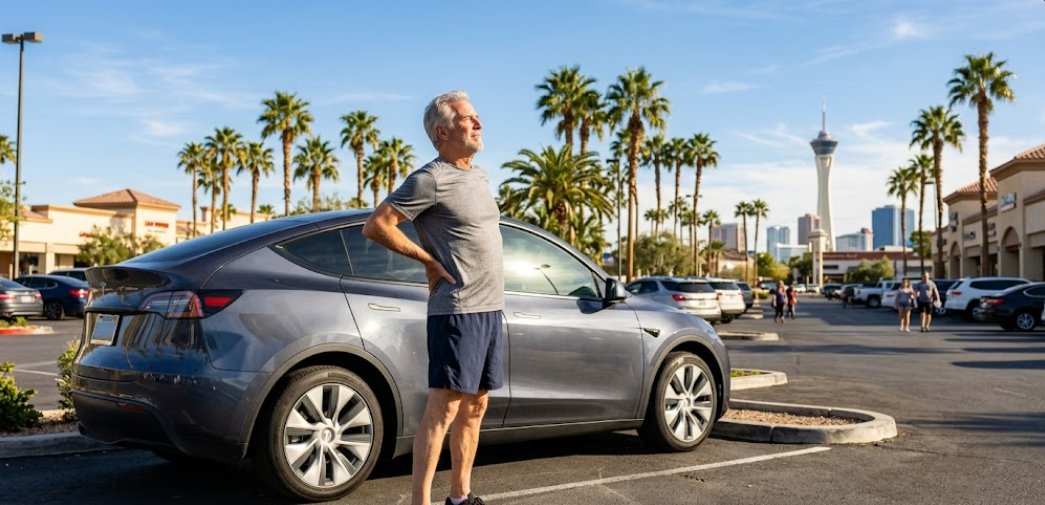
Friday night, end of a long shift. I’d done about six hours behind the wheel — airport runs, Strip pickups, a long haul out to Henderson and back. I parked the Tesla, got out, and just stood there for a second in the garage. My lower back had that familiar tightness. Not sharp. Just there.
I know that feeling well.
I started driving for Uber a few years ago, partly for the flexibility and partly because I wanted to stay active in retirement. What I didn’t expect was how much work it would take to keep my back and neck from making the decision for me. At 66, you don’t bounce back from six hours of sitting the way you did at 40.
Here’s what I’ve figured out — not from a brochure, but from actual trial and error behind the wheel.
Why Driving Hits Harder After 60
It’s not just the time. It’s the combination of things happening to your body while you sit.
According to the NIH, back pain is one of the most common medical problems in the U.S., particularly among adults over 60 — and most cases improve with targeted exercise and posture changes.
Prolonged sitting increases pressure on the lumbar discs. The road vibration transfers directly into your spine. And the fixed posture — same position, hour after hour — causes muscles to fatigue and tighten in ways they wouldn’t if you were moving around. For drivers over 40, studies show back pain prevalence is 4.67 times higher than in younger drivers. Push past four hours of daily driving and the numbers get worse.
For seniors specifically, there are extra layers. Spinal discs lose hydration and cushioning with age. Bone density decreases. Core muscles that would normally stabilize your lower back are often weaker. The same six hours that a 35-year-old shrugs off can genuinely grind on a 65-year-old.
In Las Vegas, it’s compounded by the geography. A run from the airport to Summerlin is 45 minutes each way. Strip traffic during events means long stretches of stop-and-go at 5 mph. And in summer, the heat means you stay in the car during breaks instead of getting up and walking around. Your body pays for all of it.
The Seat Setup Nobody Gets Right
Most people sit in whatever position the previous driver left things in. That’s where most driving pain starts.
Before you go anywhere, take five minutes to actually set up the seat for your body. It sounds basic. It makes a real difference.
📌 Related: Nursing Home vs Home Care Las Vegas: Real Cost Guide
Seat height and distance: Your knees should be at roughly the same height as your hips — not higher. Legs should be able to reach the pedals comfortably without locking out. If your seat is too far back and you’re reaching forward, your lower back is working constantly to keep you upright.
Backrest angle: A slight recline — around 100 to 110 degrees — is better than sitting perfectly upright. Full upright actually increases lumbar disc pressure. A gentle lean back lets your spine stack more naturally. A gel seat cushion can further reduce pressure on your tailbone during long shifts.
Lumbar support: Most car seats curve the wrong way. If you don’t have adjustable lumbar support built in, a small rolled towel or a dedicated lumbar cushion behind your lower back changes things dramatically. I started using one after my third week of Ubering and the difference was immediate.
Headrest position: The center of the headrest should be roughly level with the center of your skull. If it’s too low, it acts as a pivot point for your neck in hard stops. If it’s too high, it pushes your head forward all day. Take thirty seconds and adjust it.
The Hand Position Nobody Told You to Change
If you learned to drive decades ago, you probably learned the 10-and-2 position. Hands at ten o’clock and two o’clock on the steering wheel.
Drop it.
Modern driving instructors and ergonomics experts have moved to 9-and-3 — hands at nine and three — for good reason. It reduces the muscle tension across your shoulders and upper arms significantly over a long shift. The 10-2 position requires your arms to hold up against gravity for hours. At 9-3, your arms rest more naturally and your shoulders don’t creep up toward your ears.
I switched positions and the shoulder tension I’d been chalking up to “just getting older” decreased noticeably within a week.
Breaks — The Part Most Drivers Skip
You have to get out of the car.
Not just stretch your legs while leaning on the door. Actually get out, stand up fully, and move. Research consistently shows that sitting for more than an hour at a time accelerates muscle fatigue and disc compression. In rideshare driving, it’s easy to go two or three hours without stopping because there’s always another ride queued up.
I set a timer. Every 60 to 75 minutes, if I’m not mid-ride, I pull into a gas station or a parking lot and spend three to five minutes doing a few things:
📌 Related: Social Security COLA 2026 Las Vegas: The Real Numbers
- Stand fully upright and extend my back gently (hands on hips, slight backward lean)
- Roll my shoulders back and down five times
- Walk 30 to 50 steps — around the car if nothing else is available
- Tilt my head slowly side to side for the neck
This isn’t a workout. It takes about four minutes. It resets things enough to get through the next stretch without the stiffness building to the point where it affects how I drive.
What to Do When You Get Home
The work your body does while driving doesn’t stop hurting the moment you park. Hip flexors stay tight. The thoracic spine stays compressed. If you go straight to the couch, that’s where it stays.
Three things I do after a long shift — takes less than ten minutes total:
Hip flexor stretch: Kneel on one knee (use a mat), front leg at 90 degrees, lean forward slightly until you feel the stretch in the front of the hip on the kneeling side. Hold 30 seconds, switch sides. This counteracts hours of hip flexion from sitting.
Thoracic extension: Sit on the edge of a chair or couch, hands behind your head, and gently arch backward over the top of the seat. Not aggressively — just enough to open up the upper spine. Five reps. It undoes the forward rounding that builds up over a driving shift.
Knees to chest: Lie flat on your back, pull both knees gently to your chest, hold for 20 seconds. Decompresses the lumbar spine. Simple and effective.
I didn’t invent any of this. I started doing it after talking to a physical therapist who works with professional drivers. The difference in how I feel the next morning is real.
When to Actually See Someone
Stiffness and mild soreness after long driving days are normal. Pain that radiates down your leg is not.
If you’re feeling numbness, tingling, or sharp pain that shoots into your hip or down toward your knee, that’s a nerve signal and it warrants an actual evaluation — not just more stretching. Lumbar disc issues and spinal stenosis become more common after 60, and driving can aggravate them.
Las Vegas has good options for this. The Spine Institute of Nevada on West Sunset Road sees a lot of active seniors and professional drivers. If self-management isn’t improving things after two to three weeks, it’s worth going in rather than grinding through it.
The Longer Game
Back when I was in engineering, the principle we used was: design for the load, not just the peak. A structure that handles one big stress test but fails under consistent low-level load is a bad design.
Your spine is the same way. Six hours of driving once won’t wreck you. Six hours of driving, five days a week, with no setup, no breaks, and no recovery — that accumulates. That’s how people end up forced off the road not by age, but by avoidable wear.
I want to drive as long as it makes sense. That means treating the body like a system that needs maintenance, not a problem to push through.
Small adjustments. Consistent habits. It’s not complicated.
Frequently Asked Questions
Why does my lower back hurt more after driving than other activities?
Driving combines prolonged static posture, lumbar disc compression, and road vibration — all at once. Unlike standing or walking, which allow movement and muscle activation, sitting locks your spine in one position while vibration from the road passes directly through your seat. For seniors, reduced disc cushioning and weaker core muscles make this harder to absorb.
How often should I stop on a long driving shift?
Every 60 to 75 minutes is the practical target. Even a three-to-five minute break to stand, walk, and do basic stretching significantly reduces muscle fatigue and disc compression compared to sitting straight through. Professional driver health guidelines consistently recommend not exceeding 90 minutes without a movement break.
Does the 9-and-3 steering wheel position really make a difference?
Yes, meaningfully so over a full shift. The 10-and-2 position keeps your arms elevated against gravity for hours, creating sustained tension across the shoulders, upper back, and neck. The 9-and-3 position allows the arms to rest more naturally, reducing accumulated muscle strain — particularly relevant for older drivers who are more sensitive to postural fatigue.
What’s the best type of lumbar support for driving?
A dedicated lumbar support cushion that fills the natural curve of your lower back is more effective than a rolled towel, though either is better than nothing. Look for one that is firm enough to maintain the curve without compressing flat. Memory foam versions that conform to your shape work well for long shifts. Positioning matters — it should sit at your belt line, not higher.
When is back pain from driving serious enough to see a doctor?
See a medical professional if you experience pain that radiates into your hip or down your leg (possible nerve involvement), numbness or tingling in the legs or feet, pain that doesn’t improve with rest and stretching after two to three weeks, or any significant loss of bladder or bowel control. Mild stiffness and soreness after long drives is normal; radiating or neurological symptoms are not.
References
- PubMed — Prevalence of low back pain in professional drivers: a meta-analysis (2024)
- Spine-Health — Low Back Pain in Older Adults
- Healthline — 12 Ways to Reduce Lower Back Pain When Driving
- Uber Blog — Car Stretch Exercises for Drivers
- PMC — LBP and Driving Postures Among Drivers
- Spine Institute of Nevada — Neck and Back Pain Treatment Las Vegas
Disclaimer: This article is for informational purposes only and does not constitute professional medical advice. If you are experiencing significant or worsening pain, consult a licensed healthcare provider before making changes to your health routine.