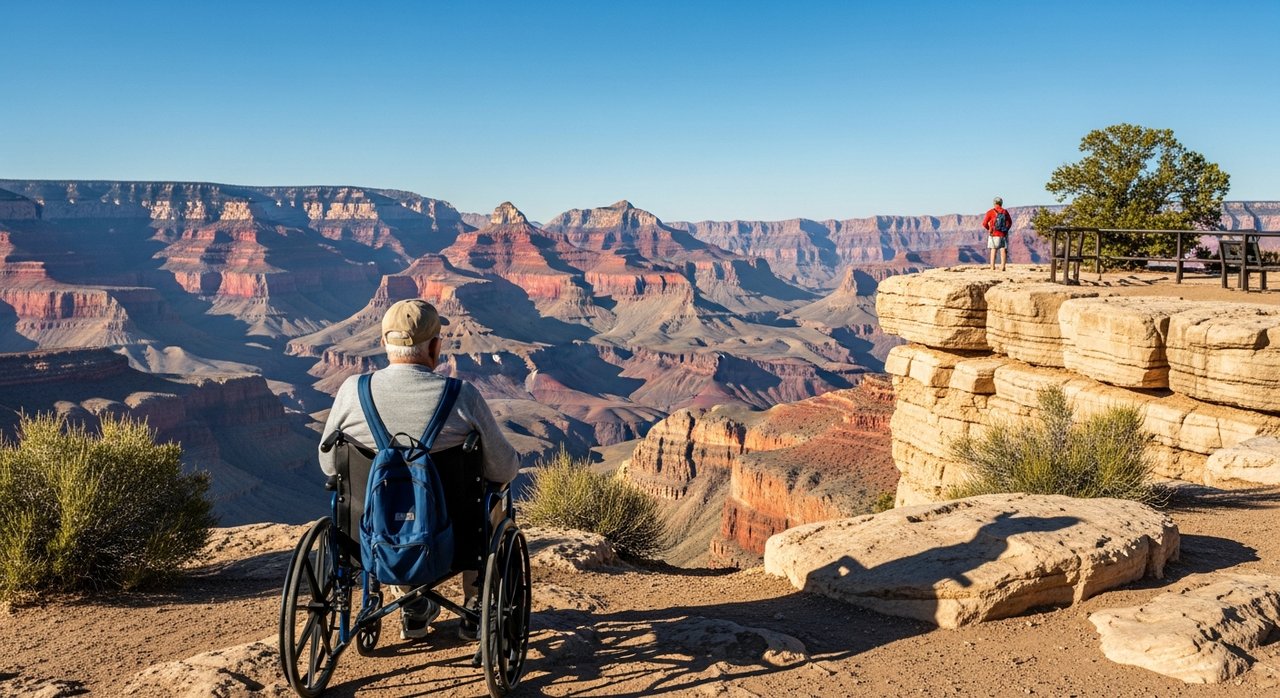
I saw a stat that stopped me mid-scroll a while back: the Grand Canyon gets around 6 million visitors a year, and according to a National Park Service accessibility survey, roughly 15% of visitors report some form of mobility limitation. That’s 900,000 people trying to figure out whether the canyon is going to be a wall they hit or a place they can actually experience. I think about my passengers — the ones who mention they want to go but aren’t sure their knees will hold up, or who have a partner in a wheelchair and don’t know if it’s even worth trying.
As a Las Vegas resident for over a decade, I’ve seen a lot of seniors ask about Grand Canyon day trips — and the accessibility question comes up every time. I’ve had passengers in my Tesla who turned around mid-trip because they didn’t know what to expect. This guide covers what actually works for seniors with mobility needs.
The honest answer: yes, it’s worth it. But only if you know which parts of the Grand Canyon actually work for seniors with limited mobility — and what the tour options from Las Vegas look like.
The South Rim Is the Right Destination for Accessible Grand Canyon Visits
The Grand Canyon has four main visitor areas: South Rim, North Rim, West Rim, and the canyon interior. If you have any mobility limitation, one of those is clearly the right choice. The South Rim.
According to the National Park Service, Grand Canyon National Park offers numerous accessible viewpoints for visitors with mobility limitations — with paved paths along the South Rim and shuttle services.
The North Rim is only open May through October and is more remote. The West Rim is privately operated by the Hualapai Nation and is known for the Skywalk — a glass bridge that requires walking on an elevated glass surface. The canyon interior means hiking, which is out of the question for most seniors with limited mobility. The South Rim is where the National Park Service has invested heavily in accessibility infrastructure, and it shows.
The Grand Canyon Visitor Center at the South Rim is fully wheelchair accessible with paved parking, ramps, and accessible restrooms. From there, the free NPS shuttle bus system serves the entire rim — buses arrive every 15 minutes, they’re equipped with wheelchair ramps, and they accommodate wheelchairs up to 30 inches wide by 48 inches long. Most standard wheelchairs and folding scooters fit. Larger motorized scooters may not — call the park’s accessibility coordinator at (928) 638-7771 before you go if you have a non-standard mobility device.
What You Can See Without Walking More Than 100 Feet
This is the part that surprises people most. The Grand Canyon is not just accessible to seniors with mobility limitations — some of the best viewpoints in the park require almost no walking at all.
📌 Related: Antelope Canyon Accessible Tour for Seniors: Las Vegas
Mather Point is the first stop most tour buses make and is widely considered the best initial viewpoint at the South Rim. The path from the shuttle stop to the overlook is paved, relatively flat, and dotted with benches. It’s less than 300 feet from the bus drop-off to the primary viewing area. If you can walk to the end of a hotel lobby, you can get to Mather Point.
Yavapai Geology Museum, about half a mile from Mather Point along the rim, has paved accessible walkways and wheelchair-accessible viewing platforms. The museum itself interprets the canyon’s geology with visual displays that don’t require standing — there are seats throughout. This is one of the best stops for seniors who want context about what they’re looking at, not just photographs.
The Trail of Time runs 1.3 miles from the Yavapai Geology Museum toward the canyon’s interior. It’s a paved, fully accessible walking path that represents geologic time — each meter represents one million years of the canyon’s formation. It’s flat. It’s shaded in sections. And it’s genuinely one of the most interesting walks in the park, even for visitors who can only do part of it.
The South Rim Trail — a continuous accessible route — covers about 5 miles total. You don’t need to do all of it. Even a quarter-mile section gives you rim views that most people only see in photos.
Tour Options From Las Vegas — What’s Available and What to Look For
The Grand Canyon South Rim is about 280 miles from the Las Vegas Strip — roughly 4.5 hours of driving. Most seniors coming from Las Vegas don’t drive themselves, and most don’t need to. There’s a full range of bus tour options departing daily from the Strip.
Standard day tour buses depart from major Strip hotels year-round — CanyonTours.com and similar operators run climate-controlled motorcoaches with panoramic windows and assigned seating. Round-trip fare typically runs $80–$120 per person, which often includes entrance fees and guide service. These tours are designed for general audiences and are not specifically accessibility-focused, but the buses are ADA compliant and the stops they make — Mather Point, Desert View — are accessible.
Limitless Travel is a specialized accessible touring company that operates vehicles with hydraulic lifts, wheelchair clamping systems, and staff trained specifically for travelers with mobility limitations. Their Grand Canyon itineraries are built around accessible viewpoints. If you or a travel companion requires specific mobility accommodations beyond what a standard tour bus provides, this is the operator to call.
📌 Related: Lake Mead Boat Tours for Seniors: Hoover Dam Cruise Gui
Grand Canyon Railway from Williams, Arizona is an alternative worth knowing about. The historic train departs Williams (about 2.5 hours from Las Vegas) and arrives at the South Rim’s Grand Canyon Village. The railway itself is ADA accessible. Upon arrival, Xanterra’s fleet of accessible motorcoaches meets guests at the station for rim tours. For seniors who find long bus rides uncomfortable, breaking the journey into a road trip to Williams and then a scenic train ride is a practical option.
One thing to look for in any tour: meal arrangements. Some budget tours use box lunches eaten on the bus. Others — including some of the comedy-guided tours like Comedy on Deck — provide sit-down meals at actual tables. For seniors with mobility limitations, being able to sit down properly for a meal midday is genuinely important. Ask before you book.
The America the Beautiful Senior Pass — Save Before You Go
If you’re 62 or older and haven’t already purchased an America the Beautiful Senior Pass, do it before your Grand Canyon trip. It costs $80 for a lifetime pass. It covers entrance fees for the Grand Canyon (currently $35 per vehicle) plus hundreds of other federal sites. One visit to the Grand Canyon recoups more than 40% of the cost. Two visits and you’re ahead.
You can purchase the pass online through the USGS store or in person at any National Park entrance. For accessible parking specifically: the pass qualifies you for reduced fees at accessible parking areas inside the park. At the South Rim, accessible parking is available near the Visitor Center with paved pathways to the shuttle system.
Practical Timing — When to Go and What to Bring
Spring (March–May) and fall (September–November) are the most comfortable times for seniors to visit the Grand Canyon South Rim. Summer temperatures at the rim can reach 85–90°F, which is manageable — but the crowds are at their heaviest in June and July. Winter visits are possible and crowd-free, but some shuttle routes reduce frequency, and temperatures at 7,000 feet elevation can drop below freezing in the morning.
Layers are essential regardless of season. Even in July, early morning rim temperatures can be 20 degrees cooler than afternoon. Seniors who run cold, especially those who spend time sitting in a wheelchair or scooter rather than walking, will feel that temperature difference sharply.
Hydration matters more here than at sea level. The elevation of the South Rim is about 7,000 feet. At that elevation, dehydration happens faster, and altitude effects — mild headaches, slightly elevated heart rate — are common for visitors coming from Las Vegas, which sits at roughly 2,000 feet. Drink more water than you think you need. Start before you arrive.
Frequently Asked Questions
Can seniors with wheelchairs fully experience the Grand Canyon?
Yes, particularly at the South Rim. Mather Point and Yavapai Geology Museum are wheelchair accessible. The Trail of Time (1.3 miles, paved) and sections of the South Rim Trail are flat and accessible. Free NPS shuttle buses have wheelchair ramps and run every 15 minutes. Most standard wheelchairs and folding scooters fit on the buses.
What is the best Grand Canyon tour for seniors from Las Vegas?
For general seniors, standard day tour buses from the Strip (CanyonTours, Viator-listed operators) are practical and comfortable. For seniors requiring specific mobility accommodations — hydraulic lifts, wheelchair clamping, specialized assistance — Limitless Travel is the most purpose-built option.
How long is the drive from Las Vegas to the Grand Canyon South Rim?
Approximately 4.5 hours (about 280 miles) via US-93 to I-40 east to AZ-64 north. Tour buses typically leave the Strip by 7:00–8:00 AM and arrive at the South Rim by late morning, allowing 3–4 hours at the rim before the return journey.
Does the America the Beautiful Senior Pass cover Grand Canyon entry?
Yes. The $80 lifetime Senior Pass (available to anyone 62 or older) covers entrance fees at all National Park Service sites, including the Grand Canyon’s $35-per-vehicle fee. It also provides discounts on some camping and tour fees. Available online or at any park entrance.
Are the NPS shuttle buses at the Grand Canyon accessible for motorized scooters?
Standard motorized scooters (up to 30 inches wide by 48 inches long) fit on most NPS shuttle buses at the South Rim. Larger mobility scooters may not. Call the park’s accessibility coordinator at (928) 638-7771 before your visit if you have a non-standard device to confirm compatibility.
References
- Accessibility — Grand Canyon National Park (NPS)
- South Rim Shuttle Bus Routes 2026 (NPS)
- Wheelchair Accessibility at the Grand Canyon — GrandCanyon.com
- Grand Canyon for Wheelers and Slow Walkers — Emerging Horizons
- Las Vegas and Grand Canyon Disabled Holiday — Limitless Travel
- Grand Canyon South Rim Bus Tours from Las Vegas — CanyonTours
Disclaimer: Prices, hours, and reservation requirements change — verify details directly with each site before your visit.