Disclosure: This post contains affiliate links. If you purchase through these links, I may earn a small commission at no extra cost to you. I only recommend products I personally find useful.
⭐ Quick Summary
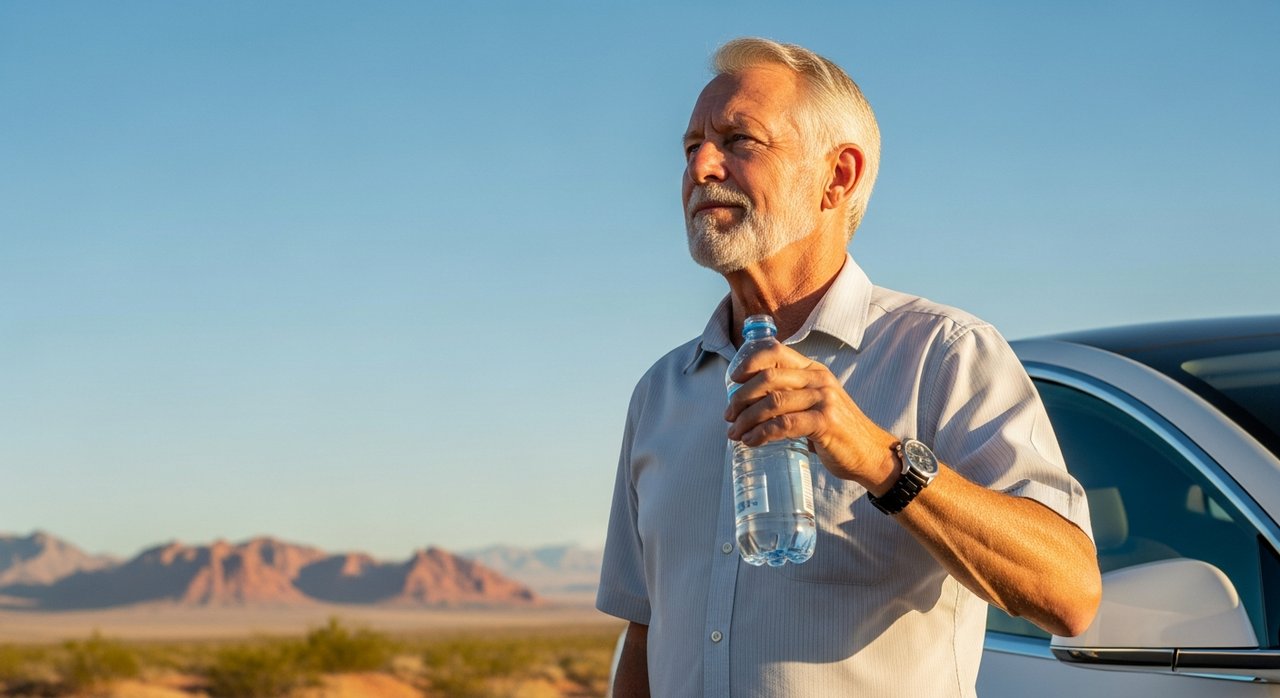
In Las Vegas, dehydration isn’t just a summer inconvenience for seniors — it’s a genuine medical emergency waiting to happen. Our desert heat evaporates sweat so fast that you can be critically dehydrated before you ever feel thirsty. Add in blood pressure meds or diuretics, and the risk goes up fast. This guide covers why seniors over 60 lose their thirst signal, what Las Vegas-specific conditions make it worse, and the practical daily habits that keep you safe when the temperature gauge hits 110°F.
It was 108°F outside. I was sitting in my Tesla on a Uber pickup near Summerlin, watching a guy in his late sixties cross the parking lot — no hat, no water bottle, moving slow. He looked fine. That’s the problem with hydration, seniors, Las Vegas heat — that combination is a quiet emergency, and most people don’t recognize it until they’re already in trouble.
I’ve been living here for over a decade, and I’ve picked up more than a few Uber passengers who told me they ended up at Sunrise Hospital after a “regular afternoon” outside. Same story every time: they weren’t out that long. They just got dizzy and couldn’t get back up.
This is what most articles miss about hydration seniors Las Vegas heat face as a specific challenge. After 60, the thirst mechanism weakens. By the time you feel thirsty out here, you’re already behind.
Hydration Seniors Las Vegas Heat — Why the Desert Makes This Uniquely Dangerous
The body’s thirst signal comes from the hypothalamus, which monitors blood sodium and triggers drinking when concentration rises too high. With age, this system gets less sensitive. And in Las Vegas, where humidity sits between 10 and 20 percent on most summer days, you’re losing moisture through skin and lungs even sitting in an air-conditioned room.
You don’t feel the sweat here the way you would back east. It evaporates instantly. The fluid loss is happening — there’s just nothing dripping to remind you.
According to MedlinePlus (National Institutes of Health), older adults are more prone to dehydration because the body’s water content decreases with age, kidneys become less efficient at conserving fluid, and the thirst sensation becomes unreliable. By the time a senior in their sixties feels thirsty in this climate, they may have already lost 2 percent of their body’s fluid — enough to cause measurable drops in concentration, balance, and energy.
📌 Related: Summer Heat Safety Guide for Las Vegas Seniors Over 60
Two percent doesn’t sound like much. In Las Vegas summer heat, it can be the difference between a good afternoon and a 911 call.
Medications Make It Worse — Here’s the Combination Most Seniors Are Already Taking
This is the part that doesn’t show up in generic hydration articles. Most seniors over 60 are managing at least one condition that requires daily medication. Several of the most common drugs prescribed to older adults directly accelerate fluid loss.
Diuretics — prescribed for high blood pressure, heart failure, and kidney conditions — work by prompting the kidneys to flush more sodium and water. In a Las Vegas summer, when you’re already losing fluid faster than in a humid climate, adding a diuretic makes the math unfavorable quickly.
ACE inhibitors and ARBs also affect kidney fluid regulation. Some antidepressants reduce thirst sensation directly. None of these drugs are being prescribed carelessly — they manage real conditions. But in a desert environment, their fluid-loss effects stack in ways that don’t always come up in the prescription conversation.
I’m not a doctor and this isn’t medical advice. But one question worth bringing to your next appointment: “Given the medications I’m taking, how much extra water should I be drinking during Las Vegas summers?” Most doctors in this city know the problem well. They’ll give you a real number.
What the Warning Signs Actually Look Like in Older Adults
Classic dehydration symptoms — dizziness, fatigue, headache, confusion — are also symptoms people associate with just getting older. I’ve talked to seniors who wrote off early dehydration for weeks because they thought they were just “having a slow day.”
The most reliable early indicator isn’t how you feel. It’s urine color. Pale yellow is the target. Dark yellow or amber means you’re behind.
Dry mouth, muscle cramps in the legs or feet, and skin that doesn’t spring back quickly when pinched lightly are all early signs that often appear before the more obvious symptoms. The cognitive ones — mild confusion, slower reaction time, difficulty staying focused — are the ones that concern me most. In an older adult, those can escalate fast in Las Vegas heat.
According to the Centers for Disease Control and Prevention, up to 40 percent of older adults are chronically under-hydrated. This isn’t a rare edge case. It’s the norm.
The Las Vegas-Specific Hydration Plan That Actually Works
The Southern Nevada Health District recommends one 8-ounce glass of water per hour during summer heat months for older adults. Not when you’re thirsty. Every hour. Most people who’ve lived here long enough have figured this out on their own.
Here’s how I do it. I keep a 24-ounce insulated bottle filled and within arm’s reach from the time I wake up until I go to sleep. Insulated matters here — a plastic bottle left in a warm car or on a sunny counter gets hot fast, and warm water is easier to skip. Cold water gets consumed. I aim to empty and refill it three times before dinner, which puts me around 72 ounces. Add coffee and whatever’s in food, and you’re in the right range for this climate.
Morning hydration before coffee matters more than most people think. After seven or eight hours of sleep in dry desert air, you wake up already slightly behind. Sixteen ounces of water before coffee is a simple habit that took me two weeks to lock in. Now it’s automatic.
For outdoor time — even brief outdoor time — the rule is water before, during, and after. If you’re spending more than ten minutes outside or in direct sun, you need to be pre-hydrated, not catching up. For those who want a reliable bottle, a stainless steel insulated bottle with handle and wide mouth keeps drinks cold for hours and is easy to use at any grip strength.
Frequently Asked Questions
How much water should seniors drink per day in Las Vegas?
Most senior health guidelines recommend 6 to 8 cups (48 to 64 ounces) of water daily for older adults. In Las Vegas during summer, that baseline needs to go up — the Southern Nevada Health District recommends one cup per hour during peak heat periods. Factor in any diuretic medications and add more. Your doctor can give you a specific target based on your health profile and prescriptions.
Can you drink too much water if you’re a senior?
Yes — overhydration (hyponatremia) dilutes sodium in the blood and is worth knowing about if you’re drinking large amounts during extreme heat. Symptoms can resemble dehydration. Ask your doctor about your specific fluid target, especially if you’re on blood pressure medications.
Does coffee count toward daily water intake?
For most people in reasonable amounts, yes. The idea that coffee dehydrates you has been largely overstated — moderate caffeine consumption contributes to fluid intake rather than canceling it out. That said, if you’re drinking several cups of coffee and skipping water the rest of the day, you’re probably still behind. Coffee can be part of your hydration picture. It shouldn’t be the whole picture.
What’s the fastest way to rehydrate if you think you’re dehydrated?
Water first, consistently, over the next several hours. Sports drinks or electrolyte tablets can help replace sodium lost through sweating, but they’re supplementary, not a replacement for water. If symptoms are significant — confusion, inability to stand, rapid heartbeat, no urination in several hours — that’s a medical situation, not a hydration situation. Don’t try to wait it out at home. Call for help.
Are there foods that help with hydration in the Las Vegas heat?
Quite a few. Cucumber, watermelon, cantaloupe, celery, lettuce, and tomatoes are all 90+ percent water by weight and contribute meaningfully to daily fluid intake. Broth-based soups do the same. If your appetite runs light in the summer heat (which is common), leaning on high-water-content foods is an easy way to get fluid without forcing extra drinking.
💧 For staying hydrated in Las Vegas heat:
Fijinhom 24 oz Insulated Stainless Steel Bottle with Handle and Wide Mouth · keeps drinks cold for hours, BPA-free, easy-grip handle
References
- MedlinePlus (NIH) — Dehydration
- Centers for Disease Control and Prevention — Water Consumption Fast Facts
- National Council on Aging — How to Stay Hydrated for Better Health
- Southern Nevada Health District — Extreme Heat Precautions for Clark County Residents
- Las Vegas Review-Journal — Record Heat Streak in Las Vegas
- National Council on Aging — 10 Reasons Why Hydration Is Important
Disclaimer: This article is for informational purposes only and does not constitute professional medical or fitness advice. Consult your doctor before starting any new health routine.