Disclosure: This post contains affiliate links. If you purchase through these links, I may earn a small commission at no extra cost to you. I only recommend products I personally find useful.
When was the last time you thought about falling? Not the abstract fear — I mean the actual, physical risk inside your own house, right now. Because I’ll be honest: I didn’t think about it either, until the day I watched my neighbor — retired engineer, sharp as a tack, 68 years old — end up in the ER because of a loose bath mat in his Henderson home. He was fine, eventually. But he spent three weeks on crutches, and the whole thing started because of a four-dollar rubber mat that had lost its grip. That morning changed how I look at fall prevention for seniors in Las Vegas. Not as a “someday” problem. As a today problem.
If you’re over 60 and living in the Las Vegas Valley, the statistics are harder to ignore than you might think.
Why Fall Prevention Seniors Las Vegas 2026 Is More Urgent Than You Realize
Here’s a number from the CDC that stopped me when I first read it: 1 in 4 Americans over 65 falls every single year. That’s not a small fringe group — that’s 14 million people. Annually. And each fall doubles your risk of falling again, which creates a cycle that’s hard to break once it starts.
According to the CDC, falls are the leading cause of both fatal and non-fatal injuries among older adults, with 3 million emergency room visits and 32,000 deaths annually in the U.S.
What makes Las Vegas specifically tricky is a combination of factors that most retirement guides don’t talk about. First, the heat. When it’s 108°F outside — which happens regularly from June through September — dehydration sets in fast, and dehydration is one of the most underappreciated causes of dizziness and balance problems in older adults. I’ve had passengers in my Tesla, retired folks visiting from cooler climates, who were visibly wobbly just from walking across a parking lot in July.
Second, our housing stock. A huge portion of Las Vegas homes — especially in 55+ communities in Summerlin and Henderson — feature polished tile floors throughout. They look beautiful. When dry, they’re fine. But a little splash from the kitchen faucet, or a damp foot stepping out of the shower, and that same polished surface becomes something close to ice. I’ve seen this in my own house.
Third, medications. The average senior over 65 takes four to five prescription drugs daily. Several of the most common — blood pressure medications, sleep aids, certain antidepressants — list dizziness and orthostatic hypotension (that dizzy rush when you stand up too fast) as side effects. The more medications, the higher the statistical fall risk. If you’re taking five or more, your risk increases substantially according to the National Institute on Aging.
Where Falls Actually Happen — It’s Not Where You Think
Most people assume the most dangerous place in the home is the stairs. In reality, for adults over 60, the bathroom accounts for the majority of serious falls. The combination of wet surfaces, minimal space to catch yourself, hard tile or porcelain at every angle, and the physical vulnerability of being unclothed makes the bathroom a genuine hazard zone.
The two highest-risk moments: stepping in or out of the shower, and getting up from the toilet. Both involve a sudden weight shift with limited support nearby. Adding a quality grab bar to both spots is, dollar for dollar, one of the best investments you can make in your physical safety.
I’ve looked at a lot of options, and for a solid, no-nonsense grab bar that actually holds weight — the AmazerBath Shower Grab Bar handles up to 500 lbs and installs with standard hardware. It’s stainless steel with a non-slip surface, and at the price point, it’s hard to argue against putting one in every bathroom in the house. And while you’re at it, a proper non-slip mat inside the shower itself — the Yimobra Non-Slip Bath Mat uses strong suction cups and machine-washes clean — takes care of the floor surface problem without any installation required.
🛒 Bathroom safety basics: AmazerBath Grab Bar (500 lb capacity) · Yimobra Non-Slip Tub Mat
Outside the bathroom, the next riskiest spots are: the entry/exit threshold (one step up or down), the kitchen when reaching for high shelves, and the bedroom at night when getting up for the bathroom in the dark. Night lights along the hallway path — the kind that activate automatically — solve that last one for about $15 total.
Free Fall Prevention Programs Right Here in Las Vegas (Most People Don’t Know These Exist)
Here’s where living in Las Vegas actually works in your favor. We have access to several legitimate, evidence-based fall prevention programs — and most of them are free or very low cost for Clark County residents.
Dignity Health’s “Stepping On” Program — This is a 7-week workshop designed specifically for older adults at risk of falling. It covers home hazard identification, strength and balance exercises, footwear choices, and building confidence after a fall scare. It’s free, and they have multiple locations: the WomensCare/Outreach Center in Las Vegas at 7220 S. Cimarron Rd. (702-616-4910), and one in Henderson at 98 E. Lake Mead Pkwy. (702-616-4378). An Australian clinical trial showed a 31% reduction in falls among participants. A U.S. study hit 50%. Those are not small numbers.
Southern Nevada Health District / Nevada Goes Falls Free Coalition — UNLV has a dedicated fall prevention research team that supports the coalition with evidence-based programs including the Otago Exercise Program and Tai Ji Quan: Moving for Better Balance. These are offered through senior centers across Clark County. Call your nearest senior center or check with the Southern Nevada Health District for current scheduling.
Nevada Aging and Disability Services Division (ADSD) — The state-level resource for finding in-home assessments and connecting with local fall prevention services. Their number is available at adsd.nv.gov. If you’re not sure where to start, they can point you toward the right program.
I’ve had passengers who’ve been through the Stepping On workshops. The consistent feedback: they went in skeptical (“I don’t need this”) and came out with a short list of changes they made at home within a week. Worth a phone call, at minimum.
Five Home Changes That Actually Move the Needle
After my neighbor’s bathroom incident, I started paying more attention to what research says actually works. Not the generic “remove clutter” advice you’ve heard a hundred times — though that’s real — but the specific, measurable changes that show up consistently in studies.
1. Grab bars in the bathroom. Already covered, but worth repeating: this is the highest-return, lowest-cost modification for most homes. A licensed handyman can install a proper wall-mounted grab bar in under an hour. Cost: $40–$80 for the hardware plus labor.
2. Adequate lighting everywhere. Older eyes need significantly more light than younger eyes to navigate safely. The standard recommendation is to double the lighting in areas like stairways, hallways, and bathrooms if you’re over 65. Motion-activated night lights for the path from the bedroom to the bathroom are a $20 solution to a real problem.
3. Secure all area rugs. Non-skid backing or double-sided carpet tape. If a rug slides even slightly, it’s a trip hazard. In Las Vegas tile-heavy homes, this comes up constantly. Either secure them properly or remove them.
4. Review your medications with your doctor. Ask specifically: “Are any of my current medications increasing my fall risk?” Blood pressure drugs, sleep aids, and certain antihistamines are common culprits. Sometimes a dosage adjustment or a different formulation of the same drug makes a meaningful difference in how you feel when you stand up.
5. Wear supportive footwear at home. Socks on tile floors are one of the most dangerous combinations in a Las Vegas home. Slippers with non-slip rubber soles — not the flat cloth kind — give you traction and ankle support. This sounds obvious until you realize most of us pad around in socks or bare feet without thinking about it.
Balance Exercises That Take 10 Minutes and Actually Work
The research on this is genuinely encouraging. You don’t need a gym membership or special equipment. The exercises that show the clearest fall-prevention benefit are simple and can be done at home, starting today.
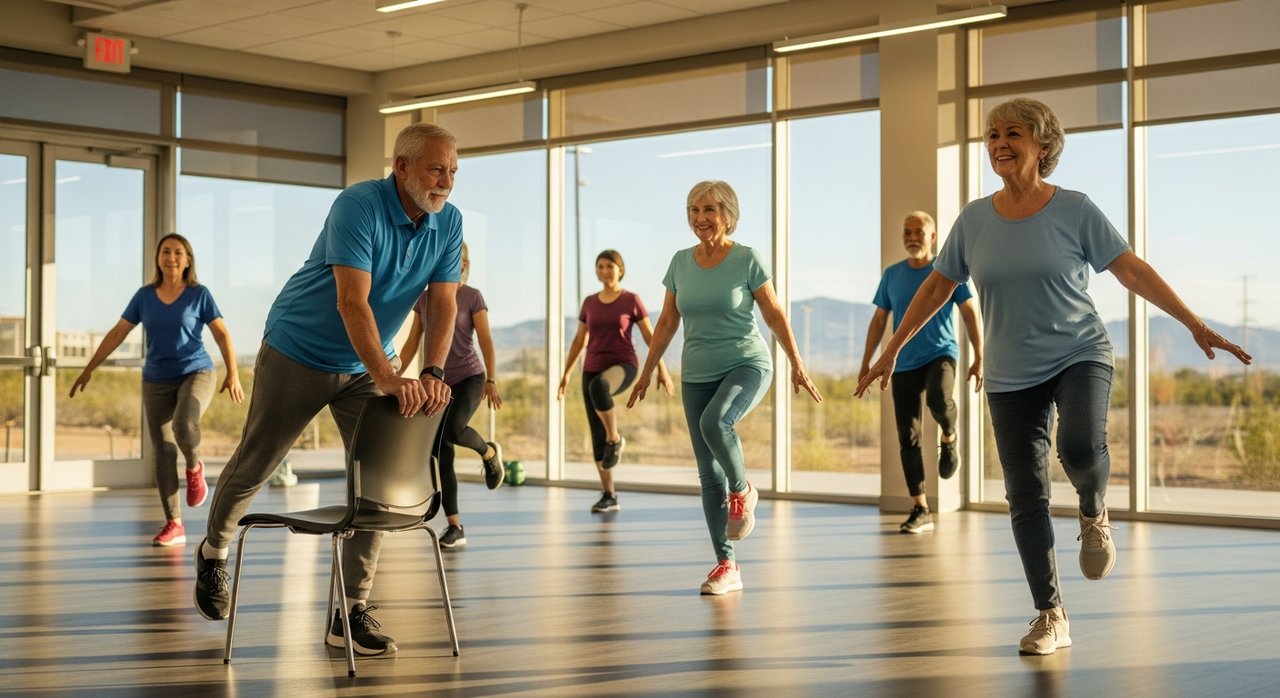
Single-leg stance. Stand behind a chair, hold the back lightly, and lift one foot a few inches off the ground. Hold for 10 seconds. Switch sides. Repeat 5 times each. When this gets easy, try it without holding the chair. This directly trains the balance reflex — the automatic correction system that catches you before a stumble becomes a fall.
Heel-to-toe walking (tandem walk). Walk slowly in a straight line, placing the heel of your front foot directly in front of the toes of your back foot, like walking a tightrope. Twenty feet, twice. This activates the vestibular system in a way regular walking doesn’t.
Sit-to-stand. From a chair without armrests (or without using your hands), stand up and sit back down slowly. Ten repetitions. This specifically strengthens the quadriceps and hip flexors that govern your ability to recover from a stumble. Johns Hopkins Medicine includes this as a core fall prevention exercise for a reason.
Tai Chi. If you want one structured practice that has the best evidence base for fall prevention in older adults, it’s Tai Chi. Multiple studies show it reduces fall risk by 20–45% in people over 60. You don’t need to become a practitioner — even a beginner class, taken twice a week, produces measurable results. The Henderson and Summerlin Recreation Centers both offer senior Tai Chi classes at very low cost.
The goal isn’t to build athletic performance. It’s to maintain the reflexes and strength that let your body catch itself when something goes wrong — because something always eventually goes wrong, and what determines whether it becomes a problem is whether your body can respond in time.
Frequently Asked Questions
How common are falls among seniors in Las Vegas specifically?
Clark County mirrors national averages closely. Nationally, 1 in 4 adults over 65 falls each year, resulting in about 3 million emergency department visits annually. In Nevada, unintentional falls are the leading cause of injury-related deaths for adults 65 and older, according to the Nevada Public Health Institute. The combination of heat, dehydration, and polished flooring common in local housing makes the Valley somewhat above-average risk.
Are grab bars hard to install in Las Vegas homes?
Standard stud-mounted grab bars require finding wall studs, which is straightforward in most construction. In Nevada tile bathrooms — especially the older HOA homes — tile drilling is involved. A licensed handyman or plumber can typically complete the installation in under an hour. The Southern Nevada Home Builders Association maintains a referral list for senior home modification work.
Does Medicare cover fall prevention programs or home modifications?
Medicare covers a fall risk assessment as part of the Annual Wellness Visit (AWV), which is free under Medicare Part B with no cost-sharing. The AWV specifically includes a review of your fall history and balance. Community-based programs like Stepping On are typically free and do not require Medicare. Physical therapy for balance improvement may be covered if prescribed by your physician.
What exercises are safe to start with if I’ve already had one fall?
Chair-supported exercises — seated leg lifts, seated heel raises, and supported single-leg stance — are the safest starting point after a fall. The goal initially is rebuilding confidence and restoring the neuromuscular pathways, not building strength. If you have access to a physical therapist, an initial evaluation is well worth requesting, particularly after a fall. Dignity Health and several PT practices in Las Vegas offer fall-specific rehabilitation programs.
How does the heat in Las Vegas affect fall risk?
Significantly. Dehydration — even mild dehydration — causes measurable reductions in cognitive speed and balance. In Las Vegas summers, a 20-minute walk or errand can produce mild dehydration in adults over 60 faster than most people expect. The practical recommendation: drink water proactively before going out, not just when you feel thirsty. Thirst sensation diminishes with age, so by the time you feel thirsty, you’re already mildly dehydrated.
References
- CDC — Facts About Falls (Older Adult Fall Prevention)
- National Council on Aging — Get the Facts on Falls Prevention
- Dignity Health Las Vegas — Free Fall Prevention Program for Seniors
- Southern Nevada Health District — Nevada Goes Falls Free Coalition
- Johns Hopkins Medicine — Fall Prevention: Balance and Strength Exercises
- National Institute on Aging — Falls and Fractures in Older Adults
Disclaimer: This article is for informational purposes only and does not constitute professional medical or fitness advice. Consult your doctor before starting any new health routine.