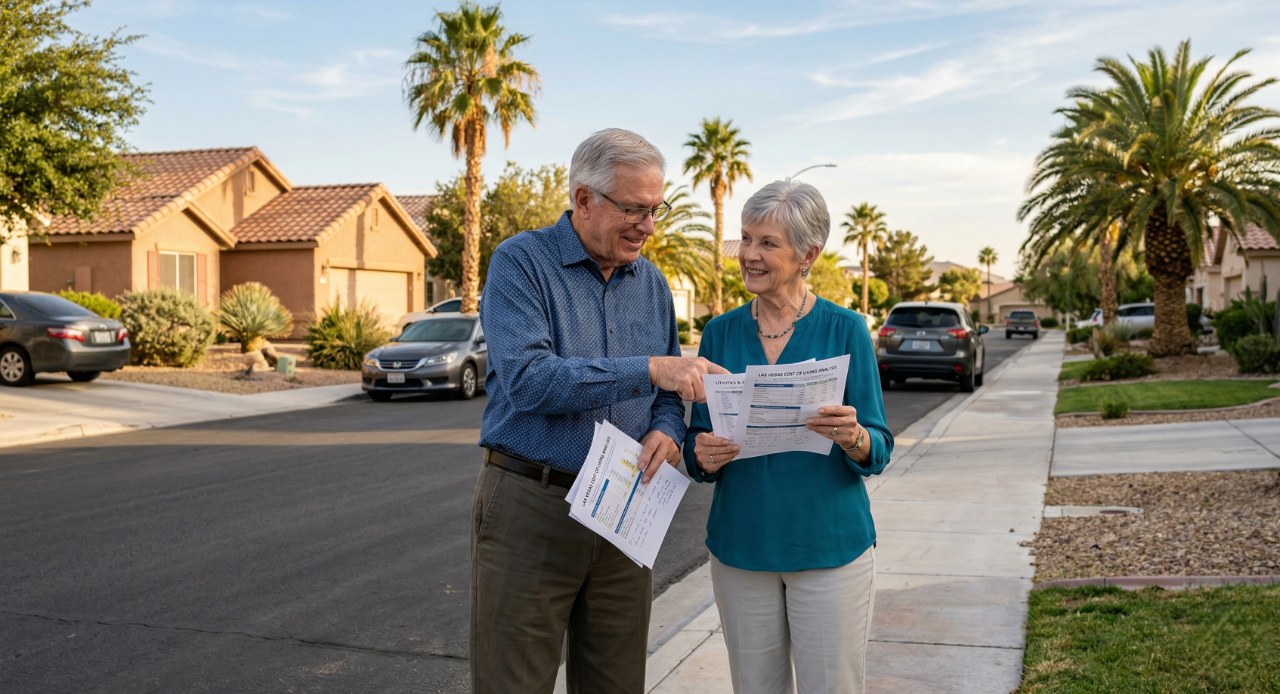
Tuesday afternoon. I picked up a passenger near the airport — retired, early seventies, originally from Arizona. She’d just flown in to look at apartments and compare her options: Spring Valley, Henderson, Summerlin, maybe somewhere further out. “I keep hearing Summerlin, Summerlin, Summerlin,” she said, staring out the window. “But I’m on a fixed income. Is there anywhere that doesn’t cost a fortune?” That’s the cost of living question every retiree eventually asks about Las Vegas.
I get that question a lot. More than people probably realize.
I’ve lived in Las Vegas for fifteen years. Before driving my Tesla for Uber, I spent years as a computer engineer, then seven years dealing cards at a locals casino on the west side of town — not the Strip, the real Las Vegas where actual residents live. I know this city in a way a real estate brochure never will.
So let me give you the honest breakdown: Spring Valley versus the suburbs everyone talks about — Summerlin, Henderson, and the outer edges of the metro. If you’re retired or close to it, this comparison matters more than most people think.
Where Exactly Is Spring Valley?
A lot of people don’t realize Spring Valley isn’t a city. It’s an unincorporated community within Clark County, sitting just west of the Las Vegas Strip. You can be at the Bellagio in about ten minutes. You can also be in a quiet residential neighborhood where your neighbors mow their lawns on Saturday morning and don’t stay up until 3 a.m.
According to Clark County Nevada, Spring Valley is one of the most populous unincorporated communities in Clark County, offering suburban amenities with proximity to Las Vegas’s major medical centers.
That’s the thing about Spring Valley. It’s close to everything Las Vegas offers — but it doesn’t feel like Las Vegas.
And Spring Valley Hospital Medical Center is right there. For anyone over sixty, that’s not a small detail. That’s a major factor.
Housing: The Numbers That Actually Matter
Let’s start with the biggest line item in anyone’s budget: housing.
As of early 2026, the median home price in Spring Valley sits around $425,000. That’s consistent with the Las Vegas metro average. You’re not getting a discount, but you’re not paying a premium either.
Summerlin is a different story. Median home prices in Summerlin South are running above $705,000. Henderson’s premium neighborhoods are in a similar range. That’s a gap of $280,000 or more for a comparable square footage — a difference that, even financed, translates to several hundred dollars more per month before you account for HOA fees, which in those communities can run $200 to $500 monthly.
That’s $280,000 more. Think about what that means in retirement savings terms.
On the rental side, Spring Valley is even more competitive. As of March 2026, one-bedroom apartments in Spring Valley are averaging around $1,330 per month. The Las Vegas metro average is closer to $1,700. That’s a savings of roughly $370 a month — or $4,440 a year — just by choosing Spring Valley over a more “prestigious” zip code.
📌 Related: Nevada Health Link vs Medicare Advantage: Spring Valley
If you’re renting a two-bedroom in Summerlin, expect to pay $1,700 to $2,200 monthly. Spring Valley two-bedrooms run noticeably lower. The gap narrows the more space you need, but the savings are real and consistent.
What About Summerlin and Henderson — Are They Worth It?
Fair question. I’m not here to trash Summerlin or Henderson. They’re genuinely nice areas.
Summerlin sits against Red Rock Canyon. If you love desert hiking trails right out your door, that’s worth something. The master-planned community has excellent infrastructure, manicured parks, golf courses. Summerlin’s cost of living index is about 130.6 — meaning it costs roughly 30% more than the U.S. national average. Henderson indexes around 110.6.
Spring Valley runs closer to the Las Vegas average, which is about 5% above the national average. So you’re looking at a 25-percentage-point difference in overall cost of living between Spring Valley and Summerlin.
On a fixed retirement income, 25% matters a lot.
Henderson has some excellent 55+ communities — Sun City Anthem is popular, well-maintained, and genuinely active. Summerlin also has age-restricted communities with comprehensive amenities. The trade-off is the price tag.
Spring Valley’s senior living options are more modest in presentation but comparable in what matters: independent living starting under $1,100 per month at some communities, proximity to healthcare, and a neighborhood crime rate that’s actually lower than the broader Las Vegas metro.
The Costs People Forget to Compare
When I was in engineering, we had a principle: model the whole system, not just the part you can see. People compare rent and home prices. They forget the rest.
Here’s what the full picture looks like across the Las Vegas metro in 2026:
Sales tax: Clark County applies a uniform 8.38% sales tax. You pay the same rate whether you live in Spring Valley, Summerlin, or Henderson. No advantage either way.
Gasoline: About $3.39 per gallon across the metro as of early 2026. Less than California, more than the national average. If you’re in Spring Valley, your commute to most daily necessities — grocery stores, medical offices, pharmacies — is shorter than from the outer suburbs, which means you’re burning slightly less gas.
Utilities: NV Energy serves the region. Electricity bills in Las Vegas average around $150 to $200 per month in summer when the air conditioning runs constantly. This doesn’t vary significantly by neighborhood. It’s a flat desert problem.
📌 Related: Nursing Home vs Home Care Las Vegas: Real Cost Guide
Car insurance: The 2026 metro average is approximately $335 per month. Rates are tied to your zip code. Inner suburban zip codes like Spring Valley sometimes run lower than outer or higher-density areas. Worth checking your specific address before assuming.
The single biggest financial advantage of Las Vegas — and this applies everywhere in Nevada — is the tax structure. Zero state income tax. None. That means no tax on your Social Security benefits, no tax on your pension, no tax on 401(k) or IRA withdrawals. For a retired couple drawing $60,000 a year in combined income, that can represent thousands of dollars in annual savings compared to California, Arizona, or most other states.
Nevada doesn’t tax retirement income at all. That’s real money.
Healthcare Access: The Factor Retirees Rank First
I had a passenger last week — 68 years old, had just moved from California. First thing he told me when he got in the car: “I made sure the hospital was close.” Not the grocery store. Not the gym. The hospital.
That’s where Spring Valley has a significant practical edge over some outer suburbs. Spring Valley Hospital Medical Center is right in the neighborhood. You’re talking minutes, not a 20-minute drive across the valley.
Henderson has St. Rose Dominican Hospital and several urgent care facilities. Summerlin has MountainView Hospital nearby. All three areas have adequate healthcare infrastructure. But for sheer proximity — especially if you’re not driving at night, or you’re managing a chronic condition — Spring Valley’s central location reduces friction in a way that matters day to day.
The Outer Suburbs: North Las Vegas, Pahrump, and Boulder City
Some retirees look even further out. North Las Vegas has lower housing costs than Spring Valley — median home prices running around $350,000 to $380,000 in many neighborhoods. But it’s farther from the Strip and from many medical centers, and parts of the area carry higher crime rates than Spring Valley.
Pahrump, about 60 miles west of Las Vegas, gets recommended sometimes for the low real estate prices. And yes, you can find homes under $300,000. But you’re giving up access — to hospitals, to shopping, to the social infrastructure that makes retirement livable. The drive back to Las Vegas for a medical appointment is not a minor inconvenience when it’s weekly.
Boulder City, just southeast of Henderson, is charming and genuinely historic — the only city in Nevada where gambling is prohibited. Housing is limited and prices have been rising. It appeals to a specific kind of retiree: someone who wants quiet and history and doesn’t mind the isolation.
Spring Valley sits in a sweet spot. Not the cheapest option available. The best value option — where cost savings are real but you’re not trading away the access and convenience that make retirement comfortable.
What I’d Tell That Passenger From Arizona
I told her what I’m telling you now.
If your budget is flexible and you want the full resort-community experience — the walking trails, the golf, the Summerlin farmers market on Saturday morning — then Summerlin or Henderson will deliver. You’ll pay for it, and you’ll know what you’re getting.
If you want to stretch your retirement dollar, stay close to the city, keep quick access to healthcare, and still live in a safe, established neighborhood — Spring Valley makes the strongest case in this metro area.
A $370 monthly savings on rent adds up to $4,440 a year. Over a ten-year retirement, that’s $44,400. In a fixed-income situation, that’s not a small number. That’s a year of living expenses.
I’ve seen what happens when people overextend on housing in retirement. I watched it at the casino table — not with gambling money, but in the conversations during slow hands at three in the morning, when people talk honestly about their situations. Overcommitting to a premium zip code is one of the quietest financial mistakes retirees make.
Spring Valley doesn’t have the brand name. It doesn’t show up in the glossy moving guides. But for someone who knows this city, it’s the neighborhood that makes the math work.
Frequently Asked Questions
Is Spring Valley safe enough for retirees?
Spring Valley’s crime rate is lower than the overall Las Vegas metro average. It’s a residential community, not a tourist corridor. Like any urban area, safety varies by specific block, but broadly, Spring Valley ranks as one of the more stable neighborhoods on the west side of the valley.
How does Spring Valley compare to Henderson for seniors specifically?
Henderson has more established 55+ communities with dedicated senior amenities, but the cost premium is significant. Spring Valley offers lower baseline housing costs and comparable proximity to healthcare, making it a stronger financial choice for retirees on fixed incomes who don’t need the full resort-community infrastructure.
Does Nevada really not tax Social Security or retirement income?
Correct. Nevada has zero state income tax. This applies to wages, Social Security benefits, pensions, 401(k) distributions, and IRA withdrawals. There’s no separate “retirement income tax” exemption to apply for — none of it is taxed at the state level.
What are typical monthly expenses for a single retiree in Spring Valley?
Based on 2026 data, a single retiree renting in Spring Valley might budget roughly $1,330 for a one-bedroom apartment, plus $150 to $200 for utilities, $200 to $300 for groceries, and $335 for car insurance — putting baseline monthly expenses (excluding healthcare and personal spending) somewhere around $2,100 to $2,200. That’s consistent with Las Vegas-wide estimates of approximately $2,600 for total single-person living costs.
Is it better to rent or buy in Spring Valley as a retiree?
It depends on your timeline and liquidity needs. With median home prices around $425,000 and rental costs averaging $1,330 for a one-bedroom, renting makes strong financial sense if you’re uncertain about your long-term location or want to preserve capital flexibility. Buying makes more sense if you plan to stay a decade or more and want to lock in housing costs without exposure to rent increases.
References
- Cost of Living in Las Vegas NV: 2026 Guide — Nevada Real Estate Group
- The Real Cost of Living in Summerlin, NV (2026 Update) — Nevada Real Estate Group
- Monthly Las Vegas Rental Report: March 2026 — Shelter Realty
- Is Las Vegas Getting Expensive to Live? 2026 — Ryan Rose Homes
- Summerlin Cost of Living: Complete Breakdown (2026) — Ryan Rose Homes
- Spring Valley Housing Market: House Prices & Trends — Redfin
- The Real Cost of Living in Las Vegas in 2025 — Brownell Team Realtors
Disclaimer: This article is for informational purposes only and does not constitute professional financial or legal advice. Housing costs, tax laws, and living expenses change over time. Consult a qualified financial advisor or real estate professional before making relocation or investment decisions.